Rated Excellent
Collection: Sheep Wool Insulation - Sheepwool Insulation - Wool
Sheep wool insulation is an excellent eco-friendly solution to insulating your space. Browse our 100% natural Sheep Wool Insulation products from Black Mountain and Sheepwool. Eco-friendly and perfect for use in attic floor spaces, stud walls, pitched roof spaces, and as floor joist underlay, they are a breathable, easy to handle, and naturally sustainable product.
We have rolls and batts (aka slabs) of this great thermal and acoustic insulation material available.
If you are insulating a floor, then the 100% Sheepwool Insulation Comfort Roll (horizontal use only) and Sheepwool SilentWool Floor Insulation are excellent options. They’re perfect for installation between joists, or laid underneath laminate or carpet flooring, to provide a draught-free room and provide acoustic dampening.
For stud wall or pitched roof insulation, the 100% Sheepwool Insulation Premium Roll is ideal. It keeps its insulation properties even if moisture is present, however, to avoid it from taking on moisture in the first place, you can combine this product with a waterproof breathable membrane.
Thermafleece sheep wool is also a good option for pitched roofs and suspended floor spaces. They’re easy to cut to size for the perfect fit. Thermafleece cosywool is great for installation in lofts, partition wall spaces where they will be fitted between framing to avoid movement.
|
Range |
Best fit |
Thicknesses shown |
|
Sheepwool Optimal |
Walls, rafters, ceilings and floors |
50, 75, 100, 140mm |
|
Sheepwool Comfort |
Horizontal loft/ceiling-level use |
100, 150mm |
|
Sheepwool Premium |
Stud walls and sloping rafters |
150, 200mm |
|
Thermafleece CosyWool |
Lofts, walls, roofs and suspended floors |
50, 75, 100, 140, 150mm |
If you’re not sure which product is most suitable for your new build or renovation project, please contact us by phone on 020 3582 6399 or chat with us Live Chat. To know more about wool loft insulation, Read Our Guide.

Collection: Sheep Wool Insulation - Sheepwool Insulation - Wool
Sheep wool insulation is an excellent eco-friendly solution to insulating your space. Browse our 100% natural Sheep Wool Insulation products from Black Mountain and Sheepwool. Eco-friendly and perfect for use in attic floor spaces, stud walls, pitched roof spaces, and as floor joist underlay, they are a breathable, easy to handle, and naturally sustainable product.
We have rolls and batts (aka slabs) of this great thermal and acoustic insulation material available.
If you are insulating a floor, then the 100% Sheepwool Insulation Comfort Roll (horizontal use only) and Sheepwool SilentWool Floor Insulation are excellent options. They’re perfect for installation between joists, or laid underneath laminate or carpet flooring, to provide a draught-free room and provide acoustic dampening.
For stud wall or pitched roof insulation, the 100% Sheepwool Insulation Premium Roll is ideal. It keeps its insulation properties even if moisture is present, however, to avoid it from taking on moisture in the first place, you can combine this product with a waterproof breathable membrane.
Thermafleece sheep wool is also a good option for pitched roofs and suspended floor spaces. They’re easy to cut to size for the perfect fit. Thermafleece cosywool is great for installation in lofts, partition wall spaces where they will be fitted between framing to avoid movement.
|
Range |
Best fit |
Thicknesses shown |
|
Sheepwool Optimal |
Walls, rafters, ceilings and floors |
50, 75, 100, 140mm |
|
Sheepwool Comfort |
Horizontal loft/ceiling-level use |
100, 150mm |
|
Sheepwool Premium |
Stud walls and sloping rafters |
150, 200mm |
|
Thermafleece CosyWool |
Lofts, walls, roofs and suspended floors |
50, 75, 100, 140, 150mm |
If you’re not sure which product is most suitable for your new build or renovation project, please contact us by phone on 020 3582 6399 or chat with us Live Chat. To know more about wool loft insulation, Read Our Guide.
-
100% Sheepwool Insulation Optimal Roll (All Sizes)
Vendor:SheepwoolfromRegular price £103.98 £124.78Sale price £103.98 £124.78 Regular priceUnit price per£0.00 -
100% Sheepwool Insulation Comfort Roll (All Sizes)
Vendor:SheepwoolfromRegular price £78.60 £94.32Sale price £78.60 £94.32 Regular priceUnit price per£0.00 -
100% Sheepwool Insulation Premium Roll (All Sizes)
Vendor:SheepwoolfromRegular price £128.99 £154.79Sale price £128.99 £154.79 Regular priceUnit price per£0.00 -
Thermafleece CosyWool Roll
Vendor:ThermafleecefromRegular price £95.23 £114.28Sale price £95.23 £114.28 Regular priceUnit price per£0.00 -
Sheepwool SilentWool Joist Insulation - 0.1m x 10m
Vendor:SheepwoolRegular price £8.45 £10.14Sale price £8.45 £10.14 Regular priceUnit price per£0.00 -
Sheepwool SilentWool Floor Insulation - 1m x 25m
Vendor:SheepwoolRegular price £123.75 £148.50Sale price £123.75 £148.50 Regular priceUnit price per£0.00 -
Sheepwool Lose Wool - 5Kg Pack
Vendor:SheepwoolRegular price £49.89 £59.87Sale price £49.89 £59.87 Regular priceUnit price per£0.00 -
Sheepwool SilentWool Carpet Insulation - 1m x 10m
Vendor:SheepwoolRegular price £111.98 £134.38Sale price £111.98 £134.38 Regular priceUnit price per£0.00 -
Window and Door Filler Untied 200m Roll
Vendor:SheepwoolRegular price £79.85 £95.82Sale price £79.85 £95.82 Regular priceUnit price per£0.00


People also searched for...
sheepwool loft insulationA short guide to sheep wool insulation
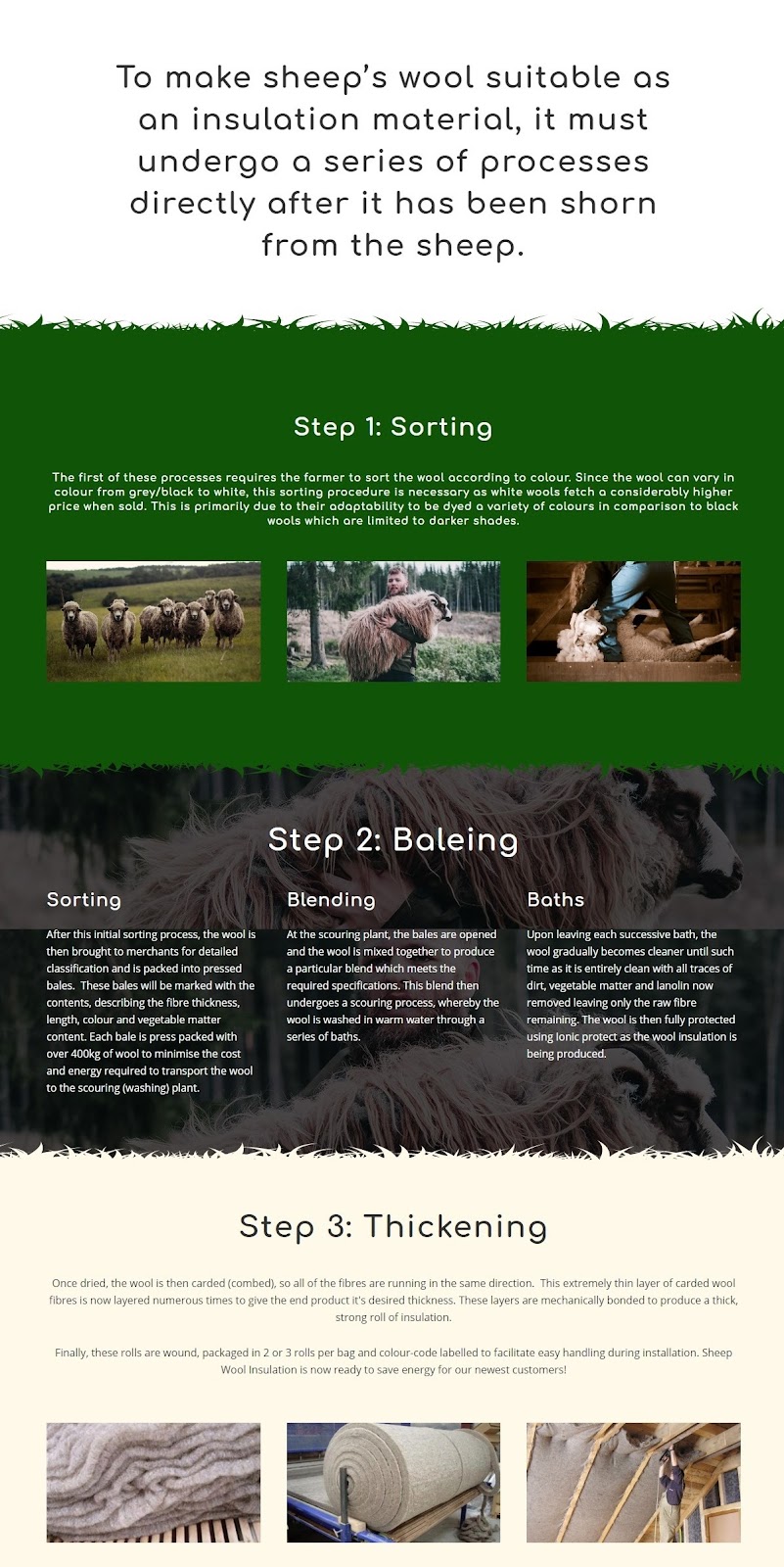
Wool insulation is made from Sheep wool fibres which are either bonded using recycled polyester or are mechanically held together to form rolls, ropes and batts. Sheep wool insulation is also known as wool insulation, natural insulation or fibre insulation. Natural sheep wool insulation is effective for both acoustic and thermal insulation.
Sheep wool insulation is a natural, recyclable, biodegradable and sustainable material. Wool insulation causes no issue to the health of people or the environment, it does not require any protective wearing while installation like fibreglass insulation. To decrease heating bills and reduce the heating cost you need to insulate your home. Sheep wool is nature's most effective insulator and has a crimped nature, which helps to form millions of tiny air pockets while packing or bonding wool fibre to trap air.
The environmental benefits of sheep’s wool insulation are many. Each kg of natural fibre product locks up about 2-3 kg of carbon dioxide which helps remove CO2 from the atmosphere. Thermal Conductivity of sheep wool insulation is between 0.035-0.4 W/mK which makes sheep wool a better insulator. Sheep wool insulation can be used throughout the entire house from loft, floors, external walls and internal walls.
Advantages of wool

- Environmental friendly
Sheep wool is fully biodegradable at the end of its life. It is entirely renewable as the supply of wool continues to grow back every year. Wool can be washed or recycled and can be used for multiple other purposes.
- Absorbs moisture
Sheep wool material can absorb and release moisture without losing any of the thermal qualities. Sheep wool will keep its insulation value even if moisture is present in the building. Sheep's wool is hygroscopic, so it can absorb around 25% of its own weight in moisture before its thermal efficiency drops. This ability to absorb water helps control humidity levels and reduces condensation within your home.
- Health benefits
Sheep wool insulation absorbs chemicals and pollutants which helps purify the air quality within your home. It is proven to absorb and neutralise harmful substances. Sheep wool insulation actually has many health benefits as it absorbs harmful and odorous substances like formaldehyde, Nitrogen Dioxide and Sulphur Dioxide to regulate a good indoor climate.
- Easy to install
Sheep wool insulation is highly recommended as it is safe to handle, non-irritant and is easy to work with. While installing wool insulation protective mask and clothing is not required makes it an easy DIY product. It is flexible, so it is easy to cut to size and can be pushed to corners easily.
- Non-flammable
Wool insulation is naturally fireproof or fire retardant. Sheep wool is the only fibre that not only naturally resists flaming, but self-extinguishes with the removal of flame. In case if the house installed with sheep wool insulation catches fire it burns much slower when compared to other types of insulation. Natural wool insulation doesn’t release any harmful chemicals while burning.
Ionic Protect
Biocide free wool protection system is known as Ionic protection. Ionic protection acts as a natural moth repellent and prevents the fibre from being eaten.
- Other Sheep wool advantages
- It’s breathable
- It offers excellent sound insulation
- It doesn’t sag over time as the natural fibres hold in the wool hold the shape.
- It doesn’t give off any nasty chemicals.
- It can be used horizontally or vertically.
- Sheep wool is 100% natural product
- By applying sheep’s wool in your house, the percentage of volatile and harmful gasses can be reduced by 50%!
Choosing sheep wool insulation by job
The main choice is not simply “which wool is best?”. Start with where the insulation has to sit and whether it must support itself. A low-density roll laid horizontally in a loft has a different job from insulation held between sloping rafters or upright studs. The Sheepwool manufacturer positions Comfort for horizontal applications, Optimal as the versatile mid-density option and Premium as the higher-density roll for vertical and sloping work. Thermafleece CosyWool is another flexible roll option for lofts, walls, roofs and suspended timber floors.
Thermal conductivity, or lambda, is the number to compare when space is tight. A lower W/mK figure means less heat passes through the material at the same thickness.
Which one do I need?
What are the downsides of sheep wool insulation?
The biggest practical drawback is cost per square metre. On the live collection, flexible sheep-wool thermal rolls cost more per square metre than many mainstream mineral-wool rolls. That premium can still make sense where breathability, comfortable handling, moisture buffering or a natural material is a priority, but it is worth pricing the whole area rather than comparing pack prices.
The second issue is thickness. Sheep wool is not a thin high-performance board. Where the build-up has very little depth, a lower-lambda rigid board may achieve the required whole-element U-value in less space. Sheep wool is strongest where the structure has enough depth for a flexible fibre insulation and where a vapour-open or moisture-buffering build-up is useful.
Pest protection also needs to be product-specific. Do not assume untreated fleece can simply be put into a wall or roof. The Sheepwool products sold here use Ionic Protect technology; the manufacturer describes it as a biocide-free treatment designed to prevent the wool becoming a food source for wool pests. Thermafleece CosyWool’s factsheet records a pass to ISO 3998 for moth/beetle proofing.
Finally, moisture buffering is not permission to ignore leaks, condensation risk or ventilation. Wool can take up and release water vapour, but bulk water from a roof leak or persistently wet construction still needs fixing. The membrane strategy must suit the complete build-up, especially in older solid-wall buildings and pitched roofs.
Do I need a vapour barrier with sheep wool insulation?
There is no safe one-line rule for every wall, roof or floor. Sheep wool is vapour permeable and hygroscopic, so it is often chosen for breathable construction, but the need for a vapour control layer depends on the whole assembly and the direction of heat and moisture flow. A vapour control layer is not the same thing as automatically wrapping the wool in impermeable plastic.
For a pitched roof, first establish whether the roof underlay is vapour-open, whether a ventilated void is required and where the airtight layer will sit. For traditional solid walls, preserving drying potential can be important. If the project is a listed building, has existing damp, or combines old masonry with new insulation, use a build-up designed for that fabric rather than copying a generic modern-wall detail.
Installing flexible wool rolls
Measure the clear distance between joists, studs or rafters before ordering. Choose the 380mm or 570mm format that gives a close fit with the least cutting. Flexible insulation should fill the intended depth without large gaps, but it should not be crushed into a shallower space. Compression changes the installed thickness and therefore the thermal resistance.
At loft level, fit the first layer between joists and add a second layer across the joists where the design calls for it. Keep eaves ventilation routes clear and do not bury heat-producing electrical equipment contrary to the equipment manufacturer’s instructions. At rafter or stud level, use the product intended to remain in that orientation and follow the manufacturer’s installation guidance for restraint, membranes and junctions.
Cut neatly around services rather than leaving channels beside pipes or cables. At perimeter junctions, close gaps that would allow air to bypass the insulation. The thermal layer works best when it is continuous; small repeated gaps can undermine a carefully specified thickness.
What is the life expectancy of sheepwool insulation?
The life expectancy of sheep wool insulation is 60-70 years. Sheep wool insulation so not requires maintenance and repair as it holds its shape well and does not slump over time.
What are the disadvantages of Sheep wool insulation?
- Lower thermal efficiency
The U-value of sheep wool insulation is around 0.16 which is more when compared to other insulation materials. Sheep wool does not offer the best thermal qualities overall.
- Expensive to install
How much does wool cost?
The cost of sheep wool insulation optimal roll with pre-cut width of 3x380mm and thickness of 75mm is around £67.90. On average sheep wool insulation (optimal roll) will cost £9.93 per square meter plus vat.
Our range of natural insulation products currently available from Insulation4less.co.uk vary from 100% sheepwool insulation to wood fibre mats. Each of these insulation materials has a unique aspects in which it creates a healthier, comfortable and more energy efficient.
Frequently asked questions
Is sheep wool a good insulation material?
Sheep wool is a practical thermal and acoustic insulation where a flexible, breathable material suits the construction. The Sheepwool manufacturer declares thermal conductivity from 0.0359 to 0.042 W/mK across its ranges. Product choice still matters because Comfort, Optimal and Premium are designed for different orientations and applications.
Can mould grow on sheep wool insulation?
Building-grade wool is designed to resist mould, but no insulation should be left persistently wet. Thermafleece CosyWool records a pass for mould resistance to CUAP 2002-01-25. Fix leaks and condensation causes first, keep the construction able to dry as designed, and replace material that has been contaminated or damaged.
Do I need a vapour barrier with sheep wool insulation?
A vapour barrier is not automatically required simply because sheep wool is being used. The correct vapour-control strategy depends on the complete wall, roof or floor build-up. Sheep wool is vapour permeable, so breathable constructions may use vapour-open layers, while other assemblies may require a specified vapour control layer.
What thickness of sheep wool insulation should I use?
Choose thickness from the required whole-element U-value and the available construction depth, not from a generic rule. The collection includes thermal rolls from 50mm to 200mm. For example, 200mm Sheepwool Premium has a calculated single-layer thermal resistance of 5.57 m²K/W using its declared 0.0359 W/mK conductivity.
Can sheep wool insulation be used between rafters?
Yes, provided the product and roof build-up are suitable. Sheepwool Premium is specifically intended for vertical and sloping applications and is available in 150mm and 200mm. Optimal can also be used at rafter level. Maintain any ventilation space required by the roof design and follow the membrane manufacturer’s detail.
Can sheep wool insulation be used in stud walls?
Yes. Sheepwool Optimal is a versatile 18 kg/m³ roll for wall applications, while Premium is a denser 20 kg/m³ option suited to vertical work. Cut or select the width for a close fit between studs, avoid gaps at noggings and services, and do not compress the insulation below its designed thickness.
Is sheep wool insulation suitable for lofts?
Yes. For a cold loft, insulation is normally placed at ceiling level between and, where required, across the joists. Sheepwool Comfort is intended for horizontal applications, while Thermafleece CosyWool is also suitable for loft use. Keep eaves ventilation clear and maintain safe clearances around relevant electrical equipment.
Is sheep wool insulation fireproof?
No. Do not describe sheep wool insulation as fireproof. Fire performance is product-specific and must be taken from the manufacturer’s declaration or test data. Thermafleece CosyWool is classified Euroclass E in its factsheet. Any required fire resistance belongs to the tested complete wall, floor or roof system.
How do I calculate how many packs I need?
Measure the area to be insulated in square metres and divide it by the selected pack coverage, then round up to whole packs. Allow for the actual framing layout, cuts and unusable offcuts. Pack coverage varies significantly: current Sheepwool thermal-roll options shown here range from 2.85 m² to 10.26 m² per pack.